



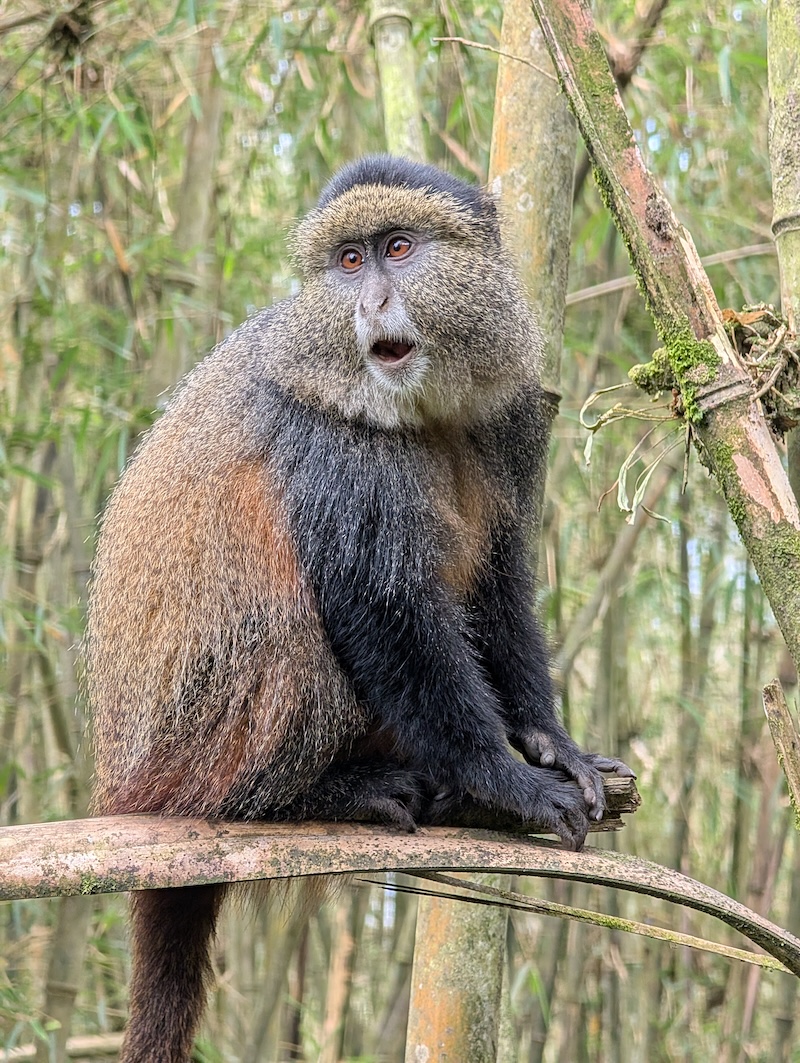
A species in the heart of Africa
Golden monkeys exist naturally only in the Albertine Rift: the narrow volcanic spine shared by Rwanda, Uganda, and the Democratic Republic of Congo. It is one of the most restricted ranges of any primate on the continent.
They share their home in Volcanoes National Park and Mgahinga with the mountain gorillas. These two different primates are thriving in these misty bamboo forests, creating a wonderful contrast. Trek gorillas one morning to see a family life that is quiet, unhurried and powerful, and Golden monkeys the next to be amidst a rapid, noisy circus.
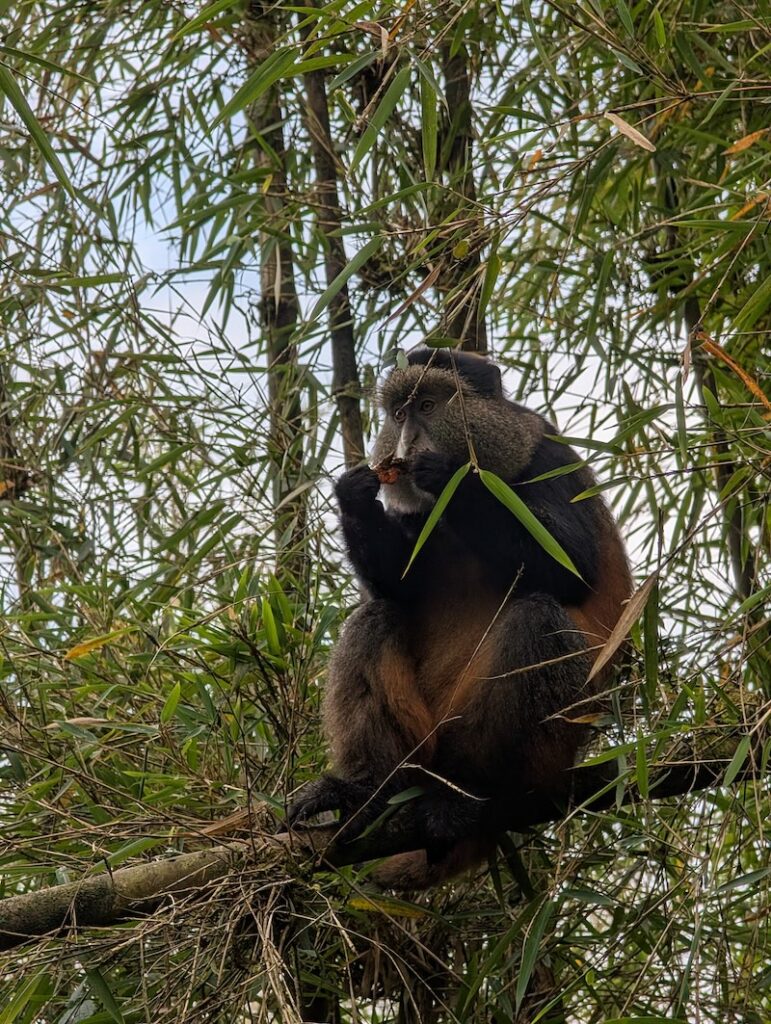
Built for the bamboo
Golden monkeys are bamboo specialists. During shoot season, they can spend most of the day feeding almost exclusively on the tender new growth, using their long tails to grip and balance. Extremely agile, the monkeys rarely sit still for long, leaping from stalk to stalk and covering ground in seconds that leaves a human far behind.
Their bright Golden-orange coats help individuals track one another through dense vegetation, a useful trait for an animal that lives in groups (and great for photographs!). Most habituated Golden monkey troops number between 30 and 80 individuals. However, Rwanda’s Volcanoes National Park has produced genuine outliers: exceptional “supergroups” of more than 150 monkeys, even approaching 200 strong. These rank among the largest social groups found in any guenon species, and the scale shows in the encounter itself. A Golden monkey troop can feel like an entire small town in motion.
Golden Monkey society
Whereas gorilla groups are built around one dominant silverback, Golden monkey society tells a more layered story. Some troops form around a single breeding male and others are multi-male groups with several adult males living in a less hierarchical structure, though it’s still common to find an ‘alpha male’. Either way, males are more likely to move between groups.
It is the female Golden monkeys who hold groups together. They generally stay in their birth troop for life, forming networks of mothers, daughters, sisters and aunts that persist for years. Usually just one infant is born to a mother, and is cared for by this extended female family.
Rather than mating exclusively with the dominant male, females will often mate with subordinates as well. Research suggests that by creating genuine uncertainty over paternity, females appear to lower the risk of infanticide, since a male is unlikely to harm an infant that could be his own. It is a more intricate system than the “alpha” model often associated with primates, and it is fairly typical of guenons as a group.
Grooming is the bonding activity that keeps all of this working. In addition to good hygiene, grooming smooths tension, creates alliances, and calms a stressed troop member. Sit quietly at the edge of a group and you will likely see dozens of these small exchanges happening at once, a constant, low-key social maintenance behind all that leaping and feeding.
Golden Monkey Quick Facts
Scientific name |
Cercopithecus mitis kandti |
Common name |
Golden Monkey |
Conservation status |
Endangered |
Range |
Virunga Massif (Rwanda, Uganda, DRC) and Gishwati-Mukura National Park (Rwanda) |
Habitat |
Montane bamboo forests and high-altitude forests (2,200–3,300 m / 7,200–10,800 ft) |
Average body length |
47–68 cm (18–27 in), excluding tail |
Tail length |
55–75 cm (22–30 in) |
Weight |
Females: 3.5–5 kg (8–11 lb); Males: 4.5–8 kg (10–18 lb) |
Lifespan |
Around 20–25 years in the wild; up to 30 years in captivity |
Diet |
Primarily bamboo shoots and leaves, and fruits, flowers, seeds, shrubs, lichens and insects |
Where can I see Golden Monkeys?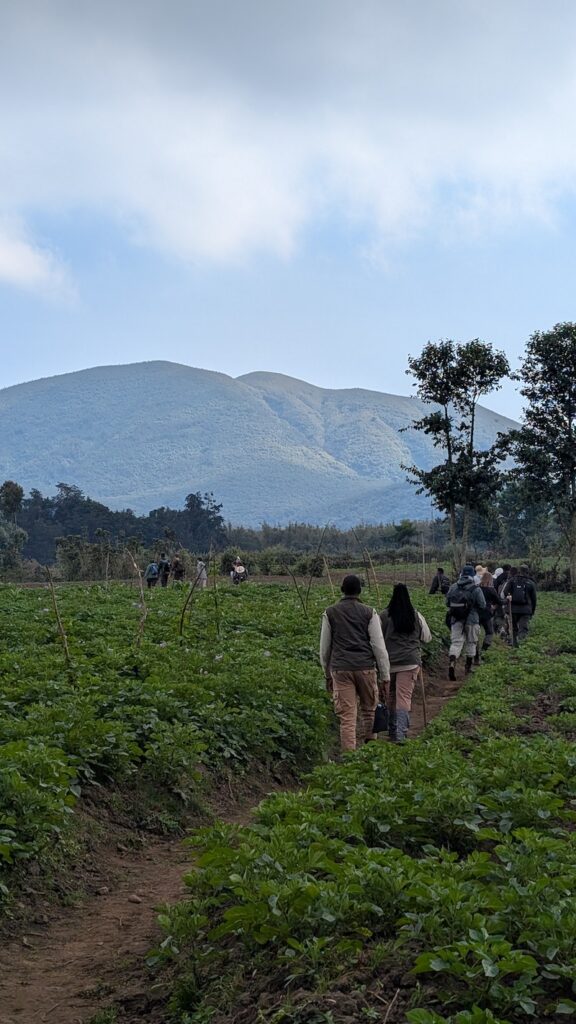
Volcanoes National Park, Rwanda
This is the largest Golden monkey population anywhere, estimated at four to five thousand individuals across dozens of troops. Treks begin at the Kinigi Visitor Centre with a briefing, followed by a gentle 30 to 45 minute walk to reach a troop. The volcanic backdrop and bamboo stands make it one of the most photogenic primate encounters in East Africa.
Gishwati-Mukura National Park, Rwanda
Rwanda’s newest park offers a quieter experience with modest Golden monkey numbers (between 150 and 190 individuals). This is a genuine conservation success story: a forest restored from degraded farmland, sheltering chimpanzees, L’Hoest’s monkeys and rich birdlife.
Mgahinga National Park, Uganda
On the northern side of the Virunga range, Mgahinga holds Uganda’s only Golden monkey population of between 400 and 1,500 individuals. One habituated troop is regularly visited, though far fewer travellers makes for a more personal experience. Mgahinga also offers a longer, more immersive Golden Monkey Habituation Experience for those who want to spend real time with a troop, particularly well suited to photographers.
The perfect companion to Gorilla Tracking
Golden monkeys are the ideal second act to their famous gorilla cousins. After the patience and quiet, an easier trek of an hour or two is rewarded with motion, colour, chatter and constant activity. Pairing the two gives a fuller picture of life in these forests.
It also matters for reasons beyond the traveller experience. Golden monkeys remain endangered, and tourism plays a genuine role in their protection by funding the anti-poaching and habitat management that has kept Rwanda’s population relatively stable. Every permit booked in Rwanda does some quiet good.
Ready to plan your trip?
We have spent more than a decade building trips through Rwanda, Uganda and beyond and Golden monkey tracking is an addition we continue to wholeheartedly recommend. Whether you’re seeing the mountain gorillas, hiking Bisoke or just a die-hard primate fan, add these bundles of fun to your journey.